
Navigate CPSO Accreditation with Expert Guidance — From Application to Approval

Opening or operating an Out-of-Hospital Premises in Ontario? The CPSO accreditation process is rigorous — and the stakes are high. Underlyte has the expertise to guide you through every standard, every inspection, and every compliance requirement — so you can focus on patient care, not paperwork.

Understanding CPSO Accreditation

The College of Physicians and Surgeons of Ontario (CPSO) conducts quality assessments of all Out-of-Hospital Premises (OHPs) in Ontario through its Out-of-Hospital Premises Inspection Program (OHPIP). Any physician performing — or intending to perform — procedures in an OHP that involve general anesthesia, parenteral sedation, regional anesthesia, or certain procedures using local anesthetic agents must notify the CPSO and pass a formal inspection before operating.

Out-of-Hospital Premises are classified into three levels (Level 1, Level 2, and Level 3) based on the complexity of procedures performed and the type of sedation or anesthesia administered. Each level carries progressively more stringent requirements for facility design, monitoring equipment, emergency preparedness, staffing, and documentation. Physicians opening or expanding an OHP must complete a New Premises Inspection Application, pay the required $500 application fee, and pass a comprehensive inspection conducted within 180 days of notification.

The accreditation process spans a broad range of standards covering patient safety, infection prevention and control (IPAC), facility design, emergency preparedness, clinical protocols, adverse event reporting, and comprehensive documentation. Inspectors evaluate everything from reprocessing procedures for medical instruments to the layout of recovery areas. Failure to meet standards can result in restrictions, conditions placed on your practice, or even facility closure — making thorough preparation essential.

Adding to the complexity, as of April 2024, Accreditation Canada acts as the inspection body for Integrated Community Health Services Centres (ICHSCs) on behalf of the Ministry of Health. Facilities that operate as both OHPs and ICHSCs must navigate the intersection of CPSO standards and Accreditation Canada requirements — including dual fee structures, overlapping reporting obligations, and sometimes conflicting standards. Underlyte has the expertise to guide you through both frameworks simultaneously.

Not Sure If Your Clinic Needs CPSO Accreditation?

Contact us for a free assessment. We’ll help you determine whether your planned procedures require OHP accreditation, which classification level applies to your facility, and what steps you need to take. Email info@underlyte.ca

How We Help

1. Readiness Assessment

We evaluate your current or planned facility against CPSO OHP Standards to identify gaps and create a clear, prioritized action plan. Whether you’re starting from scratch or preparing for renewal, our assessment gives you an honest picture of where you stand — and exactly what needs to happen next.

2. Facility Design & Layout Consulting

We advise on facility design, room layouts, equipment specifications, and workflow configurations that meet CPSO requirements — before you build or renovate. Catching design issues on paper is infinitely cheaper than fixing them in drywall. We work with your architects and contractors to ensure compliance is built in from day one.

3. IPAC Compliance

Infection Prevention and Control is one of the most scrutinized areas during CPSO inspections — and one of the most common sources of deficiencies. We develop comprehensive IPAC protocols, reprocessing procedures, sterilization workflows, and staff training programs that meet or exceed CPSO expectations.

4. Policy & Procedure Development

We create the comprehensive documentation required by CPSO: clinical protocols, emergency procedures, sedation policies, adverse event reporting, patient consent processes, quality assurance frameworks, and more. Every document is tailored to your facility’s specific procedures, staffing model, and OHP level.

5. Staff Training

We train your clinical and administrative staff on CPSO standards, IPAC protocols, emergency response procedures, and inspection preparation. Training is hands-on and practical — not just reading binders. Your team will understand the “why” behind every protocol, not just the “what.”

6. Mock Inspection

Before your actual CPSO inspection, we conduct a thorough mock inspection that mirrors the real process — evaluating your facility, documentation, IPAC practices, and staff readiness. We identify any remaining gaps, provide a detailed remediation report, and build your team’s confidence so there are no surprises on inspection day.

7. Inspection Day Support

We’re available on inspection day to provide guidance and support, ensuring your team is prepared and your facility presents at its best. While we don’t interfere with the inspection process, our presence gives your team confidence and ensures any inspector questions are addressed quickly and accurately.

8. Ongoing Compliance Monitoring

We’re available on inspection day to provide guidance and support, ensuring your team is prepared and your facility presents at its best. While we don’t interfere with the inspection process, our presence gives your team confidence and ensures any inspector questions are addressed quickly and accurately.

OHP Classification Levels

Criteria

Level 1

Level 2

Level 3

Procedures

Minor procedures

Moderate complexity

Complex procedures

Sedation

Minimal sedation

Moderate sedation

Deep sedation / General anesthesia

Infrastructure

Basic monitoring

Advanced monitoring

Full recovery and emergency capabilities

Typical Examples

Minor dermatologic procedures

Endoscopy, ophthalmology

Cosmetic surgery, interventional pain management

CPSO Scrutiny

Standard

Enhanced

Highest

Not sure which level applies?

We'll assess your planned procedures and determine the appropriate OHP classification during our readiness assessment. The level determines your infrastructure requirements, staffing obligations, and inspection scope — getting it right from the start saves time and money.

Typical Accreditation Timeline
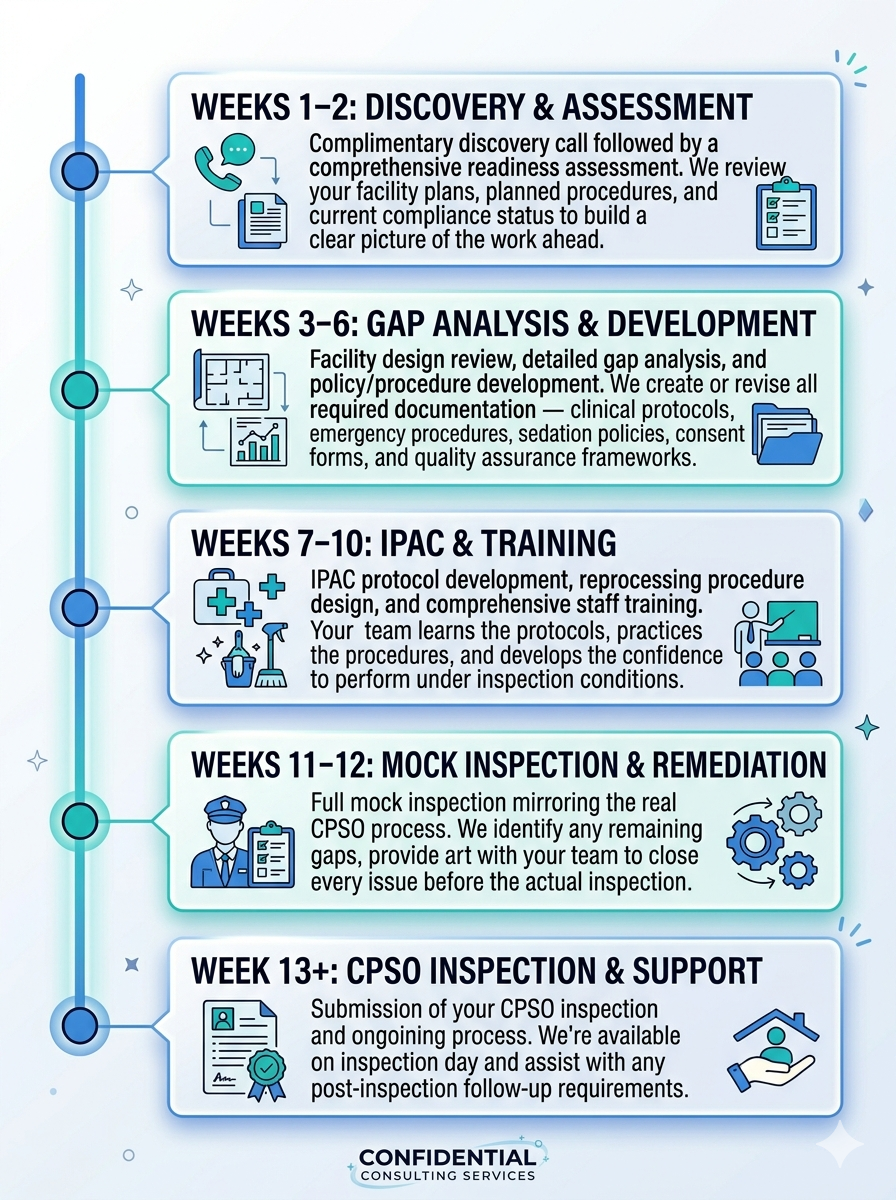
Timeline Flexibility

Timelines vary based on facility complexity and existing compliance level. Some Level 1 projects complete in 4–6 weeks; complex Level 3 facilities may require 3–6 months. We tailor every engagement to your specific situation.

Investment

CPSO accreditation engagements are priced on a project basis, reflecting the scope and complexity of your facility. Engagements typically range from $5,000 to $25,000+ depending on OHP level, facility size, number of procedures, and the level of support required.

Typical Project Includes:

  • Comprehensive readiness assessment and gap analysis
  • Facility design consultation and layout review
  • Complete policy and procedure development
  • IPAC protocol development and reprocessing procedures
  • Staff training (clinical and administrative)
  • Full mock inspection with remediation report
  • Inspection day support and post-inspection follow-up

Accreditation FAQs

What happens if our facility fails the CPSO inspection?

If your facility does not meet all CPSO standards during inspection, the college will issue a report outlining deficiencies and may impose conditions or restrictions. You’ll typically have an opportunity to address the deficiencies and undergo a re-inspection. This is exactly why our mock inspection process is so thorough — we aim to catch and resolve every potential issue before the real inspection occurs. If deficiencies are identified despite our preparation, we work with you through the remediation and re-inspection process.

OHP accreditations are subject to periodic re-inspection by the CPSO. The frequency varies, but facilities should expect routine assessments. Underlyte provides ongoing compliance monitoring services to ensure your facility stays current with evolving standards between inspection cycles, making re-accreditation significantly smoother.

Yes. If your facility has received conditions or restrictions from a previous CPSO inspection, we can assess the deficiencies, develop a remediation plan, implement necessary changes, and prepare your team for re-inspection. Our goal is to move your facility from conditional status to full compliance as quickly and efficiently as possible.

As early as possible — ideally during the design phase, before construction begins. Many accreditation deficiencies stem from facility design issues that are expensive to fix after construction. Engaging us during the planning phase ensures your architects and contractors build compliance into the facility from the start, saving significant time and cost.

Don't Navigate Accreditation Alone

From application to approval, Underlyte is with you every step of the way.

Scroll to Top